
Knowledge Base for AI: Turn Your PDFs and Docs into Answers
A knowledge base for AI turns PDFs, links, and documents into precise answers. See what to upload, how to build it step by step, and how to keep it alive.
SquadOS Team · June 4, 2026 · 7 min read
Your company already has the answer to almost everything. It is in a procedure PDF, in an old manual, in a document someone wrote two years ago that nobody opens anymore. The problem was never a lack of knowledge. It was access: the information exists, but it is buried where nobody finds it the moment they need it.
A knowledge base for AI fixes this. You upload your documents and the AI starts answering based on them, with your information, not a generic guess from the internet. This guide shows what to upload, what to leave out, how to build it step by step, and how to keep the base useful over time.
What a knowledge base for AI is

A knowledge base for AI is the set of your company’s documents that the AI uses as its source to answer. Instead of inventing or using generic knowledge, the agent consults your material and answers with what actually applies in your operation.
Under the hood, the technique is usually what is called RAG (retrieval-augmented generation). It works in three beats: the AI gets the question, retrieves the most relevant passages from your documents, and generates the answer from them. You do not need to understand the acronym to use it; you need to understand the effect.
The effect changes everything:
- Answers with your truth, not the internet average. Ask a generic AI for your refund policy and it guesses. Ask one with your base, and it answers your policy, exactly as written.
- Less hallucination. When the AI has somewhere to pull the answer from, it stops making things up. The base anchors the agent to fact.
- Answers with a source. A good base lets the agent cite which document the information came from, which is verifiable and builds trust.
It is the difference between a new hire who answers “I think it works like this” and one who opens the right manual and gives you the exact answer. The base is the manual the AI checks before it speaks.
Which documents go in (and which should not)
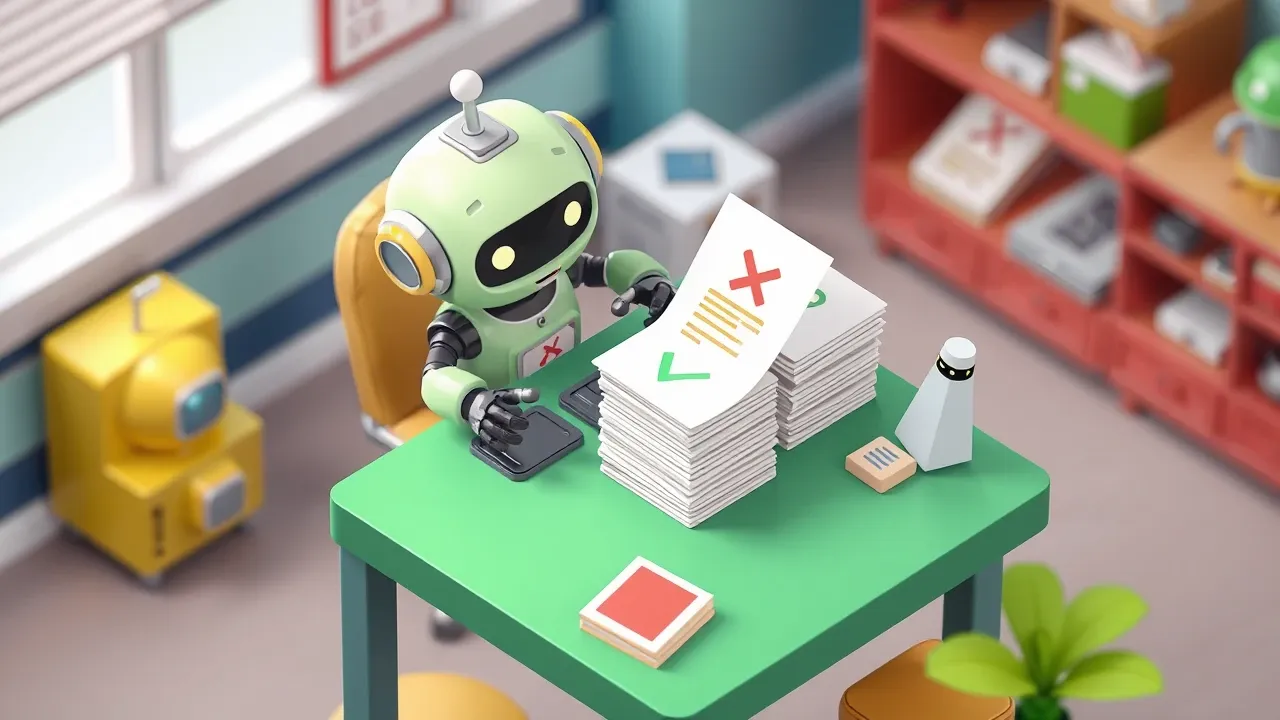
Into the base go the documents that answer real questions and are up to date. Left out are the outdated, the ambiguous, and the ones with sensitive data that has no business being there. The quality of the base defines the quality of the answer: garbage in, garbage out.
What is worth uploading:
- Current procedures and policies. How to do X, what the rule for Y is. The heart of any support or helpdesk base.
- FAQs and answers the team already gives. Those questions that repeat over email and chat. Documenting once saves a thousand replies.
- Product manuals, catalogs, tables. Specs, prices, lead times, conditions. Factual information the agent needs to answer a customer or an employee.
- Training and onboarding material. What a new hire would need to know. If it is good for training people, it is good for training the agent.
What NOT to upload, or upload with care:
- Outdated documents. Worse than no answer is the wrong one. An old policy version contradicts the new one and confuses the agent. Before uploading, confirm it is current.
- Ambiguous or contradictory content. Two documents saying different things about the same topic make the AI choose at random. Resolve the contradiction at the source, not in the base.
- Sensitive personal data with no need to be there. Do not dump a salary spreadsheet or customer data into the base of an agent that should not see it. A knowledge base needs access governance like any other system.
Practical rule: if you would not hand the document to a new hire to learn the job, think twice before handing it to the AI.
How to build the base step by step

Building a knowledge base for AI is a process of organizing, uploading, testing, and adjusting. It does not need to be perfect on day one: it needs to cover the most common questions well and improve from real use.
- List the questions the base needs to answer. Start from demand, not from files. What are the 20 questions that come up most? That tells you which document actually matters and keeps you from uploading a useless mountain.
- Gather and clean the documents. Pull together the material that answers those questions. Remove old versions, resolve contradictions, make sure each document is current. A clean document is worth more than a complete one.
- Upload to the platform. PDF, link, text, spreadsheet. A good platform indexes automatically: it breaks the content into passages and creates the embeddings (the index that lets the AI find the right chunk). You upload, it organizes.
- Test with real questions. Ask the questions from your list and see whether the agent answers correctly, with the right source. This is where you find the missing document or the one causing confusion.
- Adjust based on the test. A wrong answer almost always traces to the base: a missing, outdated, or ambiguous document. Fix the source and test again. The base improves fast on this loop.
The advantage of a chat-to-build platform is that you do not assemble an index or configure a pipeline. You upload the files, and the indexing happens on its own. The agent comes out already knowing how to consult the base, and you spend your time curating the content, which is what matters.
How to keep the base alive

Keeping the base alive means treating knowledge as something that changes, not a one-time upload. Policies change, the product changes, new questions appear. A static base ages and the agent starts getting things wrong with nobody noticing.
Three habits keep the base useful:
- Update when the source changes. Did the return policy change, a new product launch, a lead time shift? The document in the base has to change with it. Tie the base update to the process that creates the change, so it does not depend on someone remembering.
- Hunt for gaps. Every question the agent could not answer is a hole in the base. Instead of discovering it through complaints, track what went unanswered. Each gap becomes a new document, and the agent starts covering that case.
- Review what confuses. If the agent always gets a topic wrong, the problem is usually an ambiguous or contradictory source. Go to the origin, not the symptom.
The best scenario is when this loop is automatic. Some platforms detect on their own the questions the agent did not answer well, group them by similarity so it does not become a mess, and let you add the answer to the base with one click. Then the base is not just alive, it gets smarter every week without becoming yet another project to maintain.
A well-tended knowledge base is what separates an agent that seems to understand your company from one that gives a generic answer. It is the asset that makes the AI speak with your voice and your truth.
Want to turn your PDFs and documents into precise answers? With SquadOS you upload PDFs, links, and text and the indexing happens automatically, with embeddings, ready for any agent to consult. AutoLearn even detects on its own the questions without a good answer and lets you improve the base with one click, all in an environment with access governance for every document.